Names on an Australian menu can hide a whole pantry. This page says what belongs in the well-known plates, and how the three curries people argue about actually differ. It is an explainer, not a ranking of dishes, and not a claim about what any named restaurant is cooking tonight.
Australians most often meet pad Thai, green or red curry with rice, tom yum, pad krapow, satay, som tam and mango sticky rice. Each is built from a small set of seasonings — fish sauce, lime, palm sugar, chilli, garlic, shallot — plus a specific herb, spice or sour that makes the dish itself. If you want to cook four of them, the recipes page has original methods. If you want spice and allergen language, use the food guide. If you want to put them in order on a shared table, use the banquet notes.
Pad Thai
Pad Thai is stir-fried rice noodles with a tamarind-led seasoning, egg, garlic chives, bean sprouts and crushed peanut. Protein is often tofu, prawn, or both. It should taste sour and savoury before it tastes sweet. Chilli flakes sit on the side. Lime is squeezed at the table.
What is in it when it is itself: medium flat rice noodles, tamarind, fish sauce, palm sugar, garlic, egg, chives or spring onion, sprouts, peanut, lime. Pickled radish appears in some versions. Tomato sauce does not belong. A brown soy-heavy noodle is a different stir-fry; it may be good; it is not pad Thai.
Order it when you want noodles rather than rice. Share it; a whole plate per person plus curry plus rice is a starch pile. Judge it, in the Gold Coast tasting notes sense, by whether tamarind leads or toffee does.
Tom yum and tom kha
Tom yum is a hot-and-sour soup aromatic with lemongrass, galangal and makrut lime leaf, seasoned with fish sauce and lime juice. Tom yum goong adds prawns. Mushrooms are common. Nam prik pao (chilli paste in oil) adds smoke in many Australian bowls. A clear version and a lightly creamy version both exist; creaminess should be a choice.
Tom kha is a related but different soup: galangal is the name, coconut milk is the body, chicken is the common protein (tom kha gai). It should still be sour and salty. Coconut is not a licence to become dessert. Ballarat recipes cook it for cold nights; Docklands cook a saucepan tom yum for compact kitchens.
If a menu lists only “Thai soup”, ask which one. If it arrives neon and thick, you have learned about colouring and starch, not about galangal.
Som tam, larb and yum
Som tam is green papaya salad: shredded unripe papaya pounded with lime, fish sauce, palm sugar, chilli, garlic, often dried shrimp, peanut, tomato and long bean. It should be loud. Green mango versions appear where the pantry supports them — the Gold Coast salad is a cousin. Cabbage and cucumber substitutions are honest if named.
Larb (laab) is a minced-meat salad with toasted rice powder, lime, fish sauce, chilli, mint and shallot, associated with north-eastern cooking, often eaten with sticky rice. It should taste of lime and herb, not of a boiled mince cool-down.
Yum is a family of salads with that same lime–fish-sauce dressing: yum woon sen (glass noodles) is the Carlton sharehouse recipe; yum with seafood or mixed meat appears on many menus. Dressing at the last minute is the craft. Weeping salad is the tell in the Carlton reviews.
Pad krapow and other wok dishes
Pad krapow is mince (often chicken or pork) stir-fried with garlic, chilli, fish sauce and holy basil, served on rice, often with a fried egg. Holy basil is the point. Oyster sauce appears in many Australian woks as extra salt and sheen; it should not erase the basil. The recipes page method is high heat, handful of leaf, egg on top.
Other wok dishes you will meet: garlic-and-white-pepper pork (CBD recipes), morning glory with chilli and garlic, cashew chicken (more Australian-Chinese-Thai than a Bangkok essential), pad see ew (soy and wide noodles). Judge wok dishes by smell of sear. A tray-held stir-fry smells of sauce; a cooked one smells of garlic in hot oil.
Satay, grilled things and relishes
Satay in Australian Thai rooms is usually grilled meat with a peanut sauce. The peanut sauce is the allergen and the identity. Jaew and nam jim are dipping relishes of chilli, lime, fish sauce, sometimes toasted rice. Nam prik ong, the pork-and-tomato relish on the Melbourne recipes page, is a northern-style shared dip with sticky rice and raw vegetables. Relishes are how a table splits heat without ordering a second curry.
Spring rolls and fried parcels are not a cuisine. They are a start. One plate is a texture. Four plates are a stalling tactic.
Mango sticky rice and sweets
Khao niao mamuang is sticky rice with coconut and ripe mango, a seasonal classic. It is a dessert. Ripe mango does not belong inside a red curry because the coast is nearby. Coconut sticky rice is a technique (glutinous rice, steamed, coconut) distinct from coconut jasmine. If mango is out of season, a good room will say so rather than garnish green fruit with condensed milk.
Green versus red versus massaman
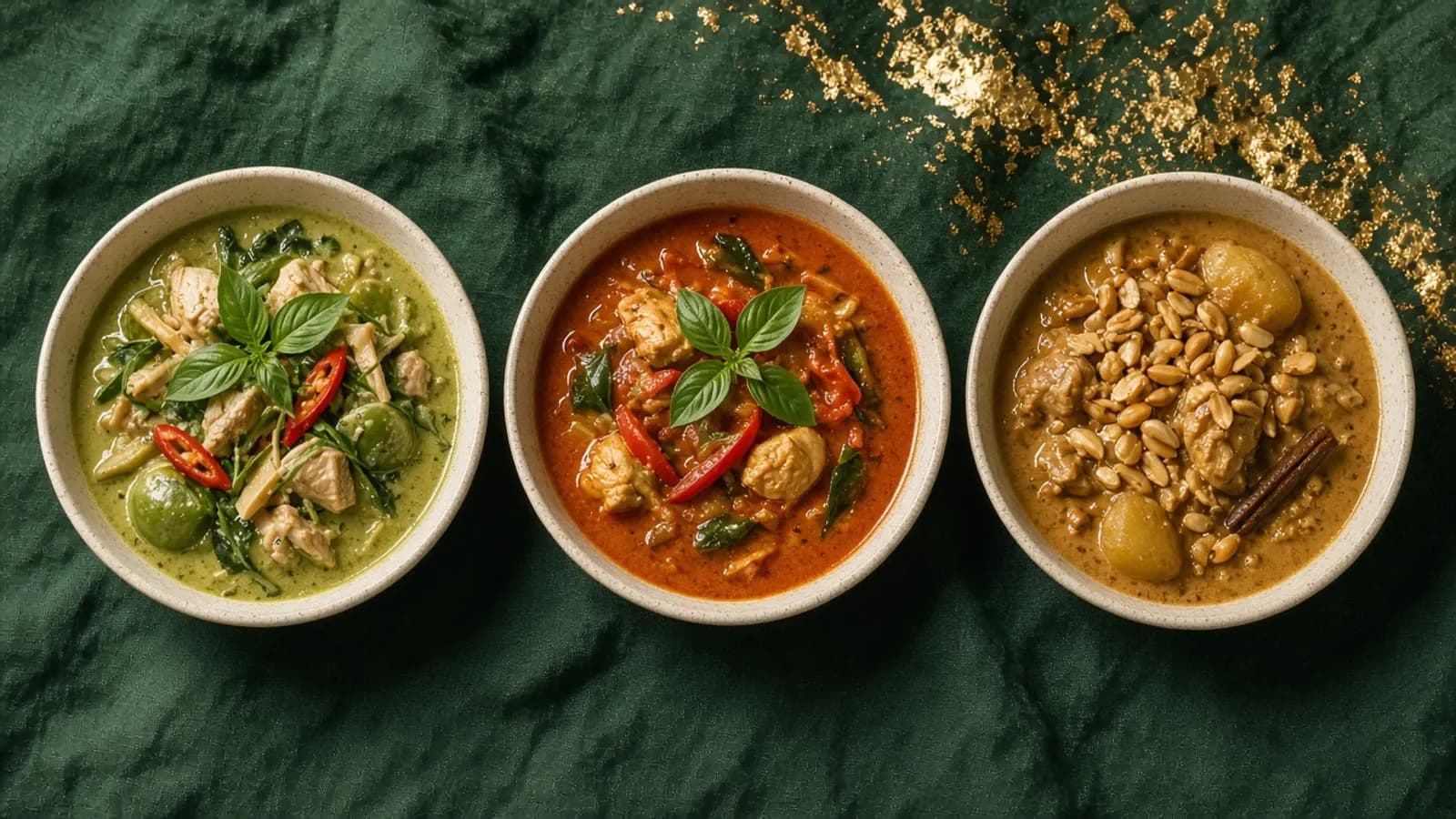
This is the argument Australian tables actually have. The three are not three colours of the same coconut soup.
Green curry paste is built on fresh green chilli, often with coriander root, garlic, shallot, lemongrass, galangal, kaffir lime zest or leaf, and shrimp paste. The curry is usually coconut-based, finished with Thai basil, sometimes with tiny eggplants. It tastes brighter and often hotter. Protein: chicken, fish, beef, tofu, vegetables. Sweetness should be a background (the Thai name includes “wan”, sweet) but not a pudding. If it tastes only of coconut and sugar, the paste was not fried or was shy.
Red curry paste uses dried red chilli as the heat and colour, with a similar aromatic base. It is deeper, more flexible, and can be a coconut curry (gaeng phed) with bamboo and basil, or a drier stir-fried curry (prik king / pad prik) with green beans and less coconut. Red is the paste you take travelling across meats and vegetables. It is not automatically milder than green; dried chilli can be fierce. It is often less herbal-fresh at the finish unless basil is added.
Massaman is a Muslim-influenced, spice-led coconut curry. Cinnamon, cardamom, cumin, clove, sometimes nutmeg, peanut, potato, onion, a meat that can wait (beef, chicken). Tamarind often supplies a sour note. It is usually milder in chilli and rounder in spice. It is slow. It is not “the mild green curry”. It is a different idea of a pot. The Geelong recipe is a home massaman-style beef; do not cook it and call it red curry because both are brownish in a photograph.
Yellow curry (gaeng garee), while we are here, sits nearer massaman than green: turmeric, spice, coconut, often potato, often chicken, often gentle. The Bendigo family pot is yellow, with a relish so heat can be added at the table. Panang is another relative: red-paste family, thicker, peanut often, less soupy, sometimes with lime leaf.
How to choose at the table:
- Want herbal and possibly hot? Green, with Thai basil showing.
- Want a flexible coconut curry that can take beef or duck or pumpkin? Red.
- Want spice, potato, a gentler chilli, a pot that waits? Massaman or yellow.
- Want no coconut? Look for tom yum, larb, som tam, krapow, a dry curry — not “a red curry without coconut”, which is a different dish and should be named as such.
A banquet should not contain green, red and massaman together unless the table is very large and you have skipped other coconut. Two coconut curries plus pad Thai plus rice is a white-and-brown meal. Swap one curry for a salad.
What “popular” does not mean
Popular in Australia is not a moral ranking and not a Thai national census. It is a description of what menus here repeat. Northern relishes, fermented fish, jungle curries without coconut, and many regional noodles appear less often. When they do appear, they are not automatically “more authentic” in a way that shames pad Thai. They are other dishes. Learn them if you want them. Do not use them as a stick to beat a well-made green curry.
Street food versus restaurant food is another false war. Pad Thai can be either. A massaman can be a home pot. A tasting method still applies: does the dish taste of its named parts?
Take this explainer to the menu, then taste. If the name on the page and the flavour in the spoon disagree, believe the spoon. That is the whole literacy this site is for — in Surfers, on Lydiard Street, in the Hoddle Grid, and at a Bendigo table with a relish on the side.
Jungle curry (gaeng pa), when you meet it, is a coconut-free, herb-and-chilli pot that should taste wild and sharp rather than creamy. It is not a failed red curry. If a menu offers it, ask whether it is actually cooked without coconut; if the bowl arrives pale and sweet, you have met a naming problem, not a jungle.