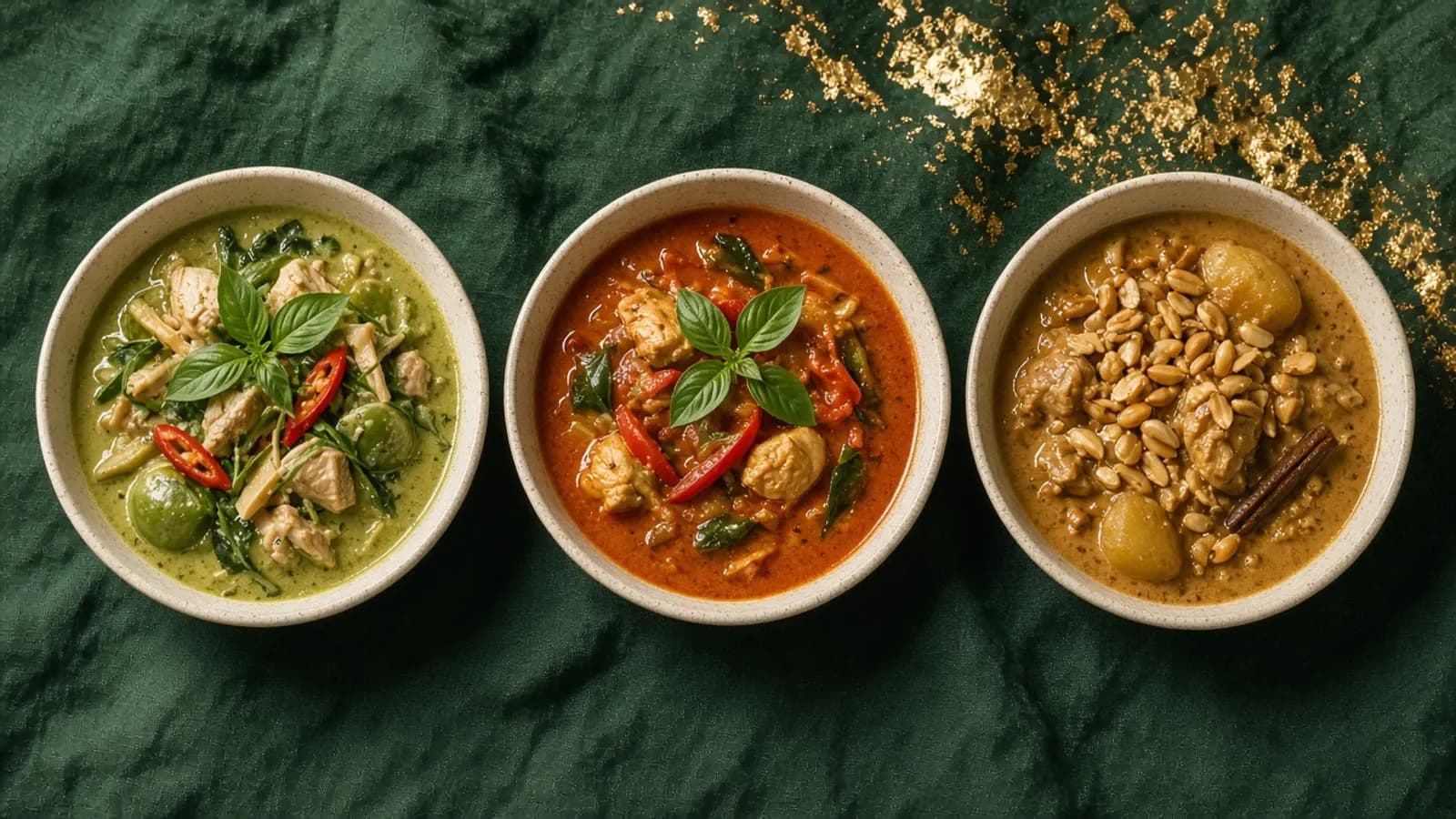
Thai food is a balance of sour, sweet, salty, bitter and heat. Many famous dishes are hot. Many are adjustable. You can ask for mild. You still need to ask clearly about gluten, fish sauce, shrimp paste and peanut, because those are not decorations; they are how a lot of the cuisine is seasoned. This guide is for Australian diners and home cooks. It is not a medical protocol, and it is not a promise about any named kitchen.
If you want to know what is in the well-known plates, open the dish explainer. If you want to cook, open how to make pad Thai at home. If you want to choose a neighbourhood, start with a city hub. This page is the asking script.
Is Thai food usually spicy?
Often, yes — in the sense that chilli is a structural ingredient in som tam, larb, tom yum, many green curries and pad krapow. No — in the sense that massaman, many yellow curries, satay, coconut soups, and plenty of stir-fried vegetables can be gentle. Thai cooking is not a single heat setting. It is a table of different dishes.
Heat also lives in different forms. Fresh bird’s eye chilli is sharp and immediate. Dried chilli in a red paste is deeper. White pepper in a garlic-pepper stir-fry is floral rather than burning. Chilli flakes on pad Thai are optional. Nam prik pao is smoky and only moderately hot. A dish can be aromatic without being a dare.
Australian menus often flatten this into mild / medium / hot. That scale is useful if you know what the kitchen means. Mild should mean fewer chillies, not more sugar. Medium should still taste of the dish. Hot should not wreck the sour-and-salt balance to prove a point. Ask what the words mean in this room. The tasting notebooks — especially Melbourne and the Gold Coast — tell you to notice whether mild still tastes of paste and herb.
Regional Thai cooking in Thailand is not one climate. North-eastern salads can be very hot and very sour. Massaman and some Muslim-influenced coconut curries are gentler and spice-led. An Australian suburban menu that offers all of these on one laminated page is already translating. Your job is to translate back: which dish is structurally hot, which is structurally gentle, and where can chilli sit on the side.
How to order mild without emptying the dish
Say it in a sentence, not a mumble. “Mild for me, please — fewer chillies, but I still want it to taste of the curry. Please do not make it sweet instead.” That second clause matters. The common kitchen response to fear of chilli is palm sugar and coconut. You will get a dessert. You asked for a milder green curry.
Better pattern for a mixed table: split the dishes, not the identity of each dish. One properly hot som tam. One gentle massaman. A basil stir-fry at medium. Rice in the middle. Chilli flakes, sliced fresh chilli, and a nam jim on the table for people who want to finish their own bowl. This is how Bendigo family pots and Ballarat tables already work, and it is how you should order in the Grid at lunch as well.
Children: rice, a coconut curry that is actually seasoned, cucumber, maybe satay if peanut is safe. Not a sugar-dump. Not a plate of chips unless the child needs that for peace and you are honest about it.
If a room only cooks one heat, order the structurally gentle dishes. Do not fight a single green curry into committee-medium. If a room will not hear the request, the choosing hubs already told you to walk.
At home, add chilli at the end. Fry a milder paste, then put sliced bird’s eye on the table. The Bendigo yellow curry with cucumber relish is designed around that split. Pad krapow can be cooked with three chillies instead of ten; it will still smell of basil if you use a handful of leaf.
Gluten — what is typically safe, and what hides
Many Thai dishes are built on rice, rice noodles, fish sauce, lime, palm sugar, chilli, coconut, herbs and meat or tofu. Those ingredients are typically gluten-free. The catches are:
- Soy sauce in stir-fries and some marinades. Light soy often contains wheat. Tamari or a labelled gluten-free soy is the swap.
- Oyster sauce in wok dishes, including many basil minces. Some bottles contain wheat; some gluten-free oyster-style sauces exist.
- Thickeners in sauces and in some satay. Ask whether a sauce is flour-thickened.
- Fried items sharing oil with battered specials.
- Seasoning packets and some curry pastes — read jars when you cook; ask when you eat out.
- Soy-based vegetarian “fish” sauces — not all are gluten-free.
Typically easier to keep gluten-free, if the kitchen is careful: som tam and many salads (check crushed peanuts only for allergy, not gluten), tom yum and tom kha (check any added chilli paste), coconut curries made from paste, coconut and fish sauce without a soy splash, grilled meats with jaew, jasmine and sticky rice, mango sticky rice.
Typically needs a conversation: pad Thai (some stalls add soy; tamarind-fish-sauce-palm-sugar need not include wheat), pad see ew and other soy-heavy noodle dishes, many stir-fries, satay, anything described as “brown sauce”.
Say “coeliac” or “gluten-free — no soy sauce unless it is gluten-free, no flour in the sauce, and please watch the fryer” rather than “no gluten if possible”. Possibility is how traces happen. The kitchen may still say they cannot be safe. Believe them. Eat rice, a salad they dress in a clean bowl, and a curry they can describe.
At home, the recipes page pad Thai is rice noodles and a tamarind dressing; keep soy out unless you choose a gluten-free bottle. Krapow needs a soy and oyster plan. Green curry and tom yum are easier.
Vegetarian and vegan — fish sauce is the catch
Vegetarian Thai food is possible and common in Australia. It is not automatic. The salt of the cuisine is often fish sauce. Many pastes contain shrimp paste (kapi). Wok dishes may contain oyster sauce. Salads may contain dried shrimp. A green papaya salad is not vegetarian until you say so.
What to say: “Vegetarian — no fish sauce, no shrimp paste, no oyster sauce, no fish sauce in the dressing. Can you cook the curry from a paste without shrimp, or use a vegetable stir-fry instead?” If they cannot, order vegetable dishes that are visibly wokked from vegetables, garlic, chilli and a soy you accept, and a coconut curry only if they are sure about the paste.
Vegan is the same conversation plus eggs (pad Thai, fried egg on krapow) and dairy (rare in classic dishes, but desserts and some fusion plates vary).
Typically easier to make vegetarian with a conversation: vegetable stir-fries, morning glory with chilli and garlic (check oyster sauce), tofu basil stir-fry, mushroom tom yum, vegetable green or red curry if the paste is clean, sticky rice with mango, cucumber relish.
Typically not vegetarian unless adapted: classic tom yum goong, nam prik ong with pork, larb gai, fish cakes, most “default” curries in a mixed kitchen where one paste tub serves all.
At home you have control. Vegetarian fish sauces exist. Soy plus lime plus a little salt can season a salad. Tofu in the Carlton yum woon sen is a different salad and a good one. Massaman paste jars must be read for shrimp; Geelong’s beef pot becomes chickpeas only after that reading.
Peanut, shellfish and other usual traps
Peanut appears as crushed nuts on pad Thai and salads, as a sauce on satay, and sometimes in massaman. It is not in every Thai dish. Say peanut clearly; do not assume a green curry is safe because it is green.
Shellfish: prawns on the menu, shrimp paste in the paste, dried shrimp on the salad, fish sauce everywhere. A person who cannot eat prawns but can eat fish sauce needs to say both facts. A person who cannot eat any fish derivative needs a vegan-style conversation.
Sesame appears in some Australian “Thai” fusion and in some condiments; it is not a core classic seasoning in the four recipes we published.
Coconut is not a nut in the everyday kitchen sense, but people who avoid it need to avoid massaman, yellow, many reds and greens, tom kha, and coconut rice. Tom yum without coconut and a basil mince become the table.
How to ask, in one breath
“We would like to share. Two of us need mild — fewer chillies, not sweeter. One person is vegetarian: no fish sauce, shrimp paste or oyster sauce. One person is gluten-free: no wheat soy, no flour. Peanut allergy at the table: no satay, no crushed peanut, clean spoons. We would like a sour salad, a gentle coconut curry, a basil stir-fry, and plenty of rice.”
That breath is the food guide. Kitchens that can hear it are the kitchens the city hubs are trying to help you recognise. Kitchens that cannot are a useful no. You do not need a ranking to walk.
Take the same breath home. Taste as you go. Lime, fish sauce, palm sugar, chilli: add, taste, add. That is Thai seasoning in an Australian kitchen, and it does not require anyone’s medal.